|
|
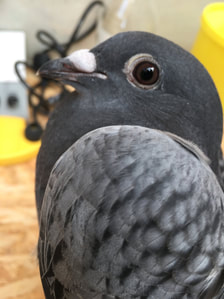
Current work: Urban CognitionCities confer many challenges to species inhabiting this environment, but several species thrive in urban environments. Many studies have revealed cognitive differences between urban and non-urban dwelling animals. There are many aspects of the environment that could be causing those differences. In previous projects, I explored the role of environmental stability in the development of cognition. In this project, I focus on the role of diet. In the lab, work on rodents, has shown that diet, particularly high-fat high-sugar diets, can impact different aspects of cognition, such as learning, memory, and social information use. One mechanism for this effect if the role played by the gut microbiota. Yet the role of diet in shaping behaviour in urban environment has received little attention. In this project, by using feral pigeons (a species that thrives in urban environments), I investigate the role of diet and the gut-microbiota during early-life, on shaping different aspects of cognition by using GPS tracked birds. This work is conducted my combining different disciplines: experimental psychology, microbiology, and movement ecology.
|
Factors Influencing Variation in CognitionIndividuals need to cope with changing threats and the need to find new resources, respond to challenges, and mediate the effects of hostile environments. Yet much individual variation exists in how individuals do so.
During my previous postdoc (Ghent University, Belgium) I examined the role of the early-life environment in driving individual differences in executive functions underlying behavioural flexibility. Previously, I also examined how social and physical environments influence measures of cognitive performance and social behaviour in great tits (University College Cork, Ireland). Throughout this work, I focused on how different tasks that putatively measure the same aspect of cognition might (or might not) be related, and aim at further developing tasks used in the lab that reflect decisions individual need to make in their environment. Before my postdocs, I worked on several projects in the UK involving cognition, mainly looking at how socio-environmental factors, and individual differences affect learning and cognitive performance, in mammals and birds. |
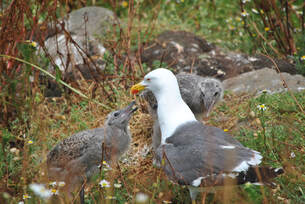
Lesser black-backed gull feeding chicks
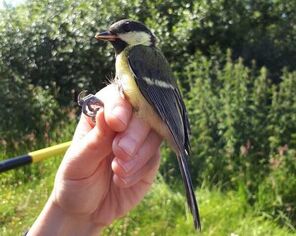
Great tit, Ireland
|
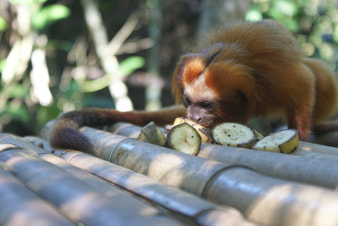
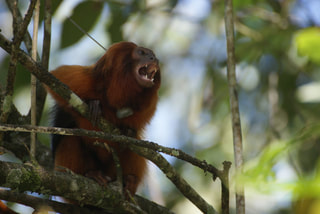
Adult golden lion tamarin from one of the habituated groups at the Poco das Antas Research Station, Brazil
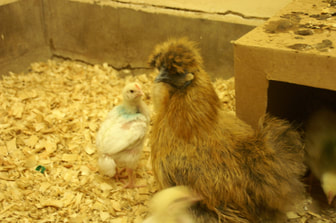
Hen and her brood, UK
|
PhD: Teaching behaviourI conducted my PhD thesis on teaching behaviour in primates and birds.
Although social learning is common, teaching behaviour in animals is much more rare. There are some species that fulfill some but not all of the criteria for teaching, and in most of those cases it is not known whether the pupil learns. For my PhD I focused on the social learning aspect in three potential teaching contexts: food transfers and food-offering calls in wild golden lion tamarins and maternal display in domestic fowls. In two of these contexts I also attempted to replicate previous findings that (allo)parents modify their behaviour to promote learning in their offspring. I found that in tamarins, both food transfers and food-offering calls help young learn what to eat and where to find food. Conversely chicks were conservative in their decision making, and used individual information over social information. Through this project, I got really interested in early-life experience, and how parental care influence future behaviour and choices of offspring. |
